
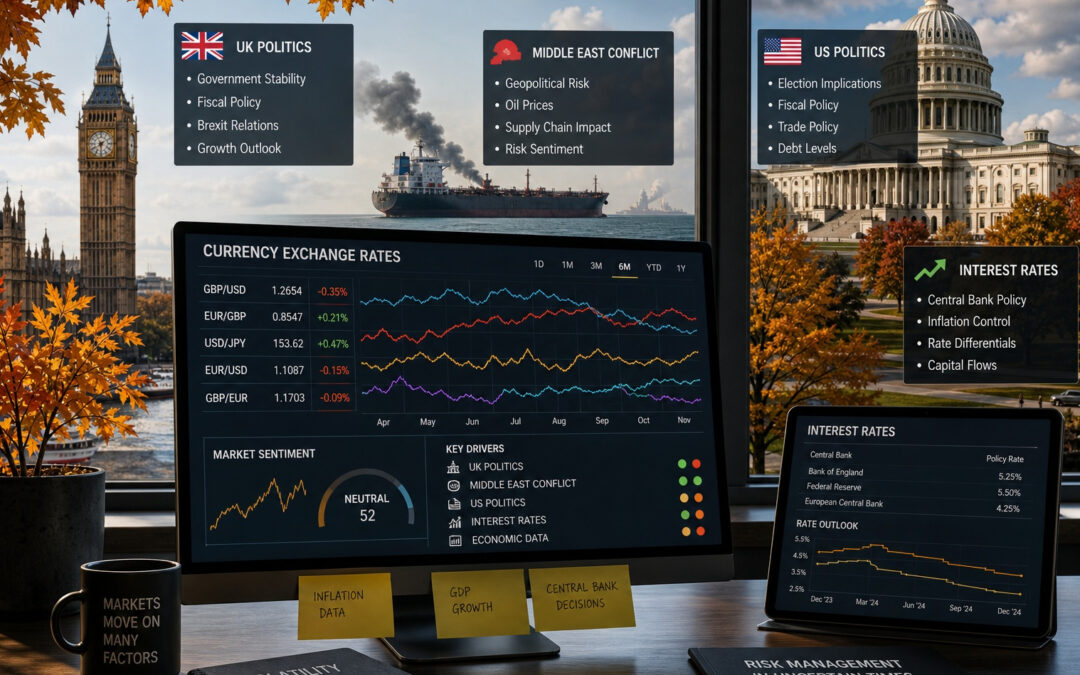
A change of prime minister and an approaching Budget will have reminded many British readers of September four years ago, when the so-called mini-Budget alarmed the bond markets and sent sterling into a tail spin. Before long GBP/USD was its weakest in decades, albeit briefly.
Could something like that be coming up again? Well, if you are buying a property overseas, there is an unusual amount happening that could move your exchange rate this autumn.
Some of it has a date attached. The UK Budget is on 28 October and the US midterm elections are on 3 November. Other risks, such as the Middle East conflict and rapidly rising government borrowing costs, could move markets with little warning.
That does not mean the pound, euro or dollar will necessarily weaken. A risk can move a currency either way. The problem for a property buyer is uncertainty.
If you have agreed to pay €300,000 for a property, for example, even a relatively small exchange-rate movement between making your offer and completing could alter its sterling cost by thousands of pounds.
Here are five dates and developments worth watching this autumn. Make sure you sign up for Smart Currency’s Daily Currency Note every morning.
1. Britain’s Autumn Budget
Why the Budget could move sterling
The Chancellor John Healey will deliver the Budget on 28 October. Markets will be particularly interested in whether the government can make its tax and spending plans add up.
One phrase you may hear repeatedly is fiscal headroom. Put simply, this is the amount of breathing space the government has before it breaks its own rules on borrowing and debt. While the Labour government has committed to sticking to its own fiscal rules (i.e. limits on borrowing) while not increasing income taxes or VAT, if investors believe the government is going to borrow considerably more than expected, they may demand a higher return for lending it money. That means higher yields on government bonds, known as gilts.
At some point, higher yields stop being good news for sterling and start looking like a vote of no confidence in the country’s finances.
What happened after the 2022 mini-Budget
The clearest recent example came in September 2022. Following the government’s Growth Plan, gilt yields surged and sterling’s trade-weighted value fell 2.5% in a single day. The Bank of England eventually intervened in the gilt market after warning of a material risk to financial stability.
That was an extreme event and there is no suggestion that October’s Budget will produce a repeat. It does, however, demonstrate how quickly fiscal policy can affect sterling.
The key risk period: October 2026
From early October until several days after 28 October, with the intensity likely to increase as Budget speculation and policy announcements emerge.
Warning signs to watch before Budget
Watch for reports of a widening gap in the public finances, unexpected tax or spending announcements and, especially, sharp rises in gilt yields. The reaction of bond investors may tell you more than the political headlines.
2. Rising debt costs in Britain, America and Europe
This is arguably the most immediate risk. Government borrowing has increased from about £500bn in 2007 to £3trillion now. Meanwhile, borrowing costs have risen sharply around the world too. On 1 September, Britain’s 10-year gilt yield rose above 5.2%, its highest since 2008, while German borrowing costs reached a 15-year high. US Treasury yields are also close to multi-year highs.
Why higher government borrowing costs matter for currencies
Governments borrow by selling bonds. When investors become less willing to hold those bonds, their price falls and the yield rises.
The yield is essentially the return investors demand for lending the government money.
Higher yields can initially support a currency because investors can earn a better return. But there is a tipping point. If yields rise because investors are worried that a government is borrowing too much, the effect can reverse.
Britain illustrates the problem particularly well. Public debt was just below £3 trillion at the end of July and government debt-interest costs were £7.7 billion in July alone. Borrowing so far this financial year has also been higher than forecast.
America faces a similar problem on a much larger scale. The Congressional Budget Office warns that growing debt leaves the US increasingly vulnerable to higher interest rates because more tax revenue has to be diverted towards servicing that debt.
What previous debt crises tell us
Europe’s sovereign debt crisis from 2010 onwards showed what happens when markets start distinguishing between countries they trust and those they believe may struggle with their debts. Borrowing costs rose sharply in several eurozone countries and worries spread from one country to another. It all sent the strength of the euro down, such that EUR/GBP fell to below 0.78 (it is currently 0.85).
Britain’s 2022 gilt crisis was a much shorter version of the same basic phenomenon: markets demanding substantially more to lend to a government they suddenly regarded as riskier.
When rising bond yields could become a bigger problem
Potentially throughout autumn. Unlike the Budget, there is no single date to circle.
The danger increases around major government borrowing announcements, inflation releases and any political event that suggests borrowing could rise further.
The bond-market warning signs to watch
Keep an eye on 10-year and 30-year government bond yields. You do not need to follow every daily movement. A sustained rise, particularly when one country’s yields start rising much faster than comparable countries, is more significant.
For the UK, the next public-finances figures on 22 September will also be closely watched.
3. Interest rates could rise again
For much of the past couple of years, the debate was about how quickly interest rates would fall. That conversation has changed.
Why higher interest rates can move exchange rates
Central banks raise interest rates when they are worried about inflation. Higher rates often make a currency more attractive because investors can receive higher returns from assets denominated in that currency.
The complication comes when different central banks move at different speeds.
If the Bank of England raises rates while the European Central Bank does nothing, for example, sterling could potentially benefit against the euro. If the ECB raises rates more aggressively, the reverse could happen.
Markets therefore react not just to what central banks do, but to what investors think they are going to do next.
The ECB has already raised rates once this year. At the Bank of England’s July meeting, three of the nine members of its Monetary Policy Committee voted to raise Bank Rate from 3.75% to 4%. Three Federal Reserve policymakers also voted for a US rate increase in July.
How rate rises strengthened the dollar in 2022
The most striking recent example was 2022. As the Federal Reserve raised US interest rates aggressively to tackle inflation, money flowed towards dollar assets. The Bank of England noted that rising US interest rates and demand for safer assets helped drive investors into the dollar, contributing to sterling’s weakness against it.
The central-bank dates that matter this autumn
September is crucial.
The Federal Reserve meets on 15-16 September, while the Bank of England announces its next decision on 17 September. Further central-bank meetings later in the autumn could then keep exchange rates moving.
Inflation signals that could point to higher rates
Inflation is the number to watch, particularly underlying or core inflation, which strips out some of the more volatile prices.
Also watch wage growth, oil prices and the language used by central bankers. Phrases such as “upside risks to inflation” or “persistent price pressures” are signs that policymakers are becoming more concerned.
4. The continuing Middle East war
The Middle East conflict is no longer simply a geopolitical risk sitting in the background. It is already affecting inflation, interest-rate expectations and bond markets.
How conflict can feed through to exchange rates
The transmission mechanism is largely oil and gas. Higher energy prices make transport, manufacturing, food production and household energy more expensive.
That raises inflation. Central banks may then feel compelled to increase interest rates, while economic growth can suffer at the same time.
That combination is particularly awkward for currencies because investors are trying to work out which countries will suffer most and which central banks will respond most aggressively.
The Bank of England now expects UK inflation to rise again later this year as higher energy costs work their way through the economy. The ECB has similarly said that the Middle East energy shock is pushing inflation higher.
What previous energy shocks tell us
The oil shock following the 1973 Arab-Israeli war provides the classic example. Restrictions on oil supplies caused energy prices to soar, intensifying inflation across western economies and leaving central banks facing extremely difficult choices.
More recently, the 2022 energy shock following Russia’s invasion of Ukraine showed how rapidly higher energy prices can feed through into European inflation, central-bank policy and exchange rates.
Why this risk could emerge at any time
There is no particular date, and the impact on exchange rates has been happening day by day since the conflict began at the end of February.
The greatest danger would come from a significant escalation affecting oil production or shipping, particularly movement through the Strait of Hormuz, one of the world’s most important routes for oil and gas exports.
That means this is the risk most capable of moving your exchange rate overnight.
Oil and energy warning signs to watch
Oil prices are the most useful market indicator.
Watch also for disruption to shipping, attacks on oil infrastructure and signs that energy prices are feeding into broader inflation. If oil rises sharply at the same time as government bond yields, markets are probably becoming more concerned about another inflation shock.
5. The US midterms and a potentially constrained presidency
America votes in its midterm elections on 3 November. Every seat in the House of Representatives and 35 Senate seats are being contested.
For currency markets, the important issue is not simply which party “wins”. It is what the result means for US economic policy.
Why the midterms matter for the dollar
If President Trump’s Republicans lose control of one or both houses of Congress, passing major domestic legislation could become considerably harder.
You may hear this described loosely as creating a lame-duck presidency. Trump would in fact remain president, with substantial executive powers, so “politically constrained” is more accurate. But a hostile Congress could block legislation, investigate the administration and make agreement on tax, spending and debt considerably harder.
Markets could also start looking beyond Trump towards the 2028 presidential election much earlier.
Conversely, a strong Republican result could be interpreted as giving the administration more freedom to pursue its programme.
Either outcome could alter expectations for government borrowing, tariffs, inflation and Federal Reserve policy, all of which matter for the dollar.
What happened after previous midterm elections
Midterms frequently change the balance of power in Washington. Barack Obama’s Democrats lost the House in 2010 and Donald Trump’s Republicans lost it in 2018.
The immediate currency reaction to a midterm result is often less dramatic than after a presidential election. The bigger impact can come afterwards if divided government leads to confrontation over budgets, taxes or the federal debt ceiling.
The key risk period around 3 November
From the final fortnight of October through 3 November, followed by the days or potentially weeks required to establish control of Congress.
There could then be a second period of uncertainty between the election and the new Congress taking office in January 2027.
Political and market signals to watch
Opinion polls matter, but betting markets and forecasts for control of the House and Senate can be more useful than individual national polls.
For currencies, watch what bond markets do as expectations change. If investors conclude that an election result will mean significantly more borrowing or political gridlock, US Treasury yields and the dollar could react before polling day itself.
What does all this mean if you need to buy euros or dollars?
The important point is not to predict which of these five risks will actually materialise.
You could correctly predict the Budget, the war and the US election and still get the exchange rate wrong because currencies react to what markets expected beforehand. Instead, think about the risk you personally face.
If your overseas property costs €300,000 and you know you must pay for it in November, you already have a currency exposure today. Leaving all your money in pounds means you are effectively accepting whatever GBP/EUR rate happens to be available when the payment becomes due.
One option is a forward contract, which allows you to fix an exchange rate for a payment you will make later. That can remove the uncertainty over the sterling cost of an agreed property purchase.
Another approach can be to secure part of the currency and leave part exposed to future movements.
Neither approach is about predicting the market. It is about deciding how much exchange-rate uncertainty you are comfortable carrying while the Budget, interest-rate decisions, the Middle East conflict and US elections play out.
If you have a property payment coming up this autumn, Smart Currency Exchange can talk you through the available ways to manage that exposure and help you decide when and how to transfer your funds.