
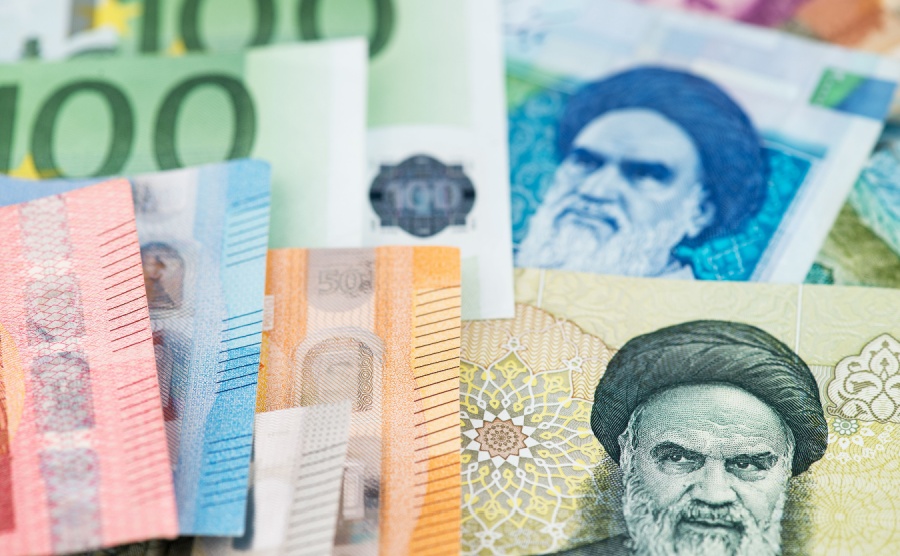
The attacks on Iran from the USA and Israel, and the retaliation from Iran against neighbouring countries, is already having global repercussions. For anyone with significant transactions to make overseas, into any currency, there will be an impact on exchange rates.
Your exchange rate today
Sterling has remained relatively resilient so far, but volatility has increased. Compared with previous shock events – Brexit, the pandemic, the 2022 mini-Budget – current currency moves remain contained.
GBP/USD has moved up and down in fits and spurts, but is barely 1% down overall on the US dollar since the war began on 1 March. It remains close to 10% up on where it was when Trump started his second term 14 months ago.
GBP/USD past month
GBP/EUR has been quietly powering upwards since hostilities began on 1 March, gaining close to 2%.
GBP/EUR past month
Let’s investigate why exchange rates are moving and why, despite being at war, the US dollar has gained most.
Risk appetite
Global investors with huge amounts of money at stake put their money into assets that are safe or risky, or at least safer or riskier, according to their risk “appetite” and the potential rewards.
When conflict erupts, no-one entirely knows where it will end. So, when something like the attack on Iran occurs, money is switched to assets seen as safe, avoiding risk in a mode known as “risk off”. The safest asset is normally – even when the USA is directly involved – the US dollar. There are other ‘safe haven’ currencies, generally the Japanese yen, Swiss franc and euro, which also tend to strengthen in riskier times, or commodities such as gold and silver.
The pound is no longer really taken as a safe haven. Indeed because the UK is a service based economy, sterling tends to depend on the fortunes of businesses that buy those services, which means shadowing stock markets. Business is being directly impacted by energy prices, amongst other war-related worries, and hence the FTSE 100 index has fallen more than 6% in two weeks and the S&P 500 around half that.
Fuel costs and energy prices
Rising oil prices are the most immediate effect of the war, with Iran blocking the Straits of Hormuz, through which a fifth of the world’s oil is transported. The US seems not to have foreseen this problem and so cargo ships are so far unprotected, leading to the spike in oil prices from $60 to over $100 per barrel.

Will oil get through the Straits of Hormuz? ( Below the Sky / Shutterstock.com)
The International Energy Agency has said that “The war in the Middle East is creating the largest supply disruption in the history of the global oil market.” The impact is already being felt on petrol station forecourts, but the bigger impact will be on transport costs of everyday goods. Oil doesn’t just affect pump prices. Transport and manufacturing rely on it too, so higher oil costs ripple through the wider economy. Globally, households will see a renewal of the cost of living crisis, just when inflation was almost under control again.
Interest rates and mortgages
Central banks including the Bank of England (BoE) are required to keep inflation as close to 2% as possible while keeping the economy growing and unemployment down. Until 1 March this was regarded as having been achieved almost painlessly – dubbed “the immaculate disinflation” – with more interest rate cuts expected this month in both the UK and USA.
The war and the spike in oil prices has put this seriously in jeopardy, and interest rates could even increase (another cause for stock markets falling). That has already impacted mortgage rates with a likely knock-on impact in deadening the property market.
Inflation outlook
Economists now expect inflation to grow to 3% again if the oil price stays high. According to The Economist, a $10 uplift in oil prices per barrel typically adds between 0.1 to 0.2 percentage points to annual inflation, and the oil price is now up about $40.
The Bank of England remains committed to lowering inflation using its monetary policy tools. However, it has limited power to control commodity-driven cost pressures. For households, the result could be sustained high borrowing costs and slower reductions in goods prices.
Pensions and investments
The fall in stock markets will also affect the value of your pension. If investor confidence further evaporates, so will your pension pot. Inflation worries tend to weigh on equities, particularly in sectors sensitive to borrowing costs like construction, technology and consumer finance.
For investors nearing retirement or relying on income from stock portfolios, diversification and caution are key. Speak with a financial adviser before making large changes to your holdings, especially under volatile conditions.
Need guidance during uncertain times?
Geopolitical events are unpredictable. Markets can react quickly, then reverse just as fast.
What matters most is having a structured currency plan in place rather than reacting to headlines.
If you have an upcoming transfer, speak with your account manager to review your exposure and discuss the options available. A calm, measured approach is often the most effective way to protect your budget during uncertain times.